VEVOR vs BotaBay: Food Choppers Compared by Specs
As an Amazon Associate we earn from qualifying purchases. Links on this page are affiliate links.
This VEVOR vs BotaBay food chopper comparison looks at two manual commercial dicers. Both units use aluminum frames and stainless steel blades for durable vegetable prep. They share a commercial intent and manual operation. The main difference lies in their cutting mechanisms and blade variety. VEVOR uses a push-style handle with a single fixed cut size. BotaBay offers a lever-style design with four interchangeable blades for multiple cut options.
Key differences
| Aspect | VEVOR Commercial 1/4-Inch Vegetable Chopper | BotaBay 19-Inch Lever Food Chopper with 4 Blades |
|---|---|---|
| Operation Mechanism | Pull-down handle | Lever style |
| Cut Size Options | 1/4 inch | 6-wedge, 1/4 inch, 3/8 inch, 1/2 inch |
| Blade Count | 1 (plus 2 spares) | 4 |
| Blade Material | 420J2 stainless steel | 304 stainless steel |
| Weight | 5.07 pounds | 10 pounds |
| Dimensions | 6.1 x 7.9 x 18.5 inches | 18 x 7 x 7 inches |
Which one should you choose?
Choose VEVOR Commercial 1/4-Inch Vegetable Chopper if
- You need a lighter, more compact unit for easier storage
- You primarily prepare French fries with a consistent 1/4 inch cut
- You prefer a push-down action over a lever squeeze
Choose BotaBay 19-Inch Lever Food Chopper with 4 Blades if
- You require multiple cut sizes like wedges or 1/2 inch dice
- You want a heavier, more stable base for commercial volume
- You prefer the leverage advantage of a long-handled lever mechanism
Verdict: Choose the VEVOR model if you need a lightweight, single-cut solution for high-volume fries. Select the BotaBay chopper if you need versatility with four blade options and a sturdier lever-based design.
VEVOR vs BotaBay Chopper Specs
Blade Variety
BotaBay offers significantly more cutting options than VEVOR. The BotaBay unit includes four blades, allowing you to dice vegetables into 1/4-inch, 3/8-inch, and 1/2-inch cubes, or create 6-wedge slices. This versatility suits various recipes without needing extra tools. In contrast, the VEVOR model comes with only a single 1/4-inch blade set, though it includes two spare blades of the same size. If you need uniform wedges or larger dice, BotaBay is the clear choice. VEVOR is limited to small, consistent cubes.
Operation Mechanism
The two choppers use different manual mechanisms that affect your effort. BotaBay features a lever-style design, which uses mechanical advantage to reduce the force needed to push food through the blades. This can be easier on your hands during heavy prep. VEVOR uses a push-down handle that relies on direct downward pressure. While functional, this method may require more physical strength, especially for harder vegetables like carrots or potatoes. Your preference depends on whether you prioritize leverage ease or a simpler, direct push action.
Blade Material
Both brands use food-grade stainless steel for hygiene and durability, but the specific grades differ. BotaBay employs 304 stainless steel, which is widely recognized for its high corrosion resistance and stability in food environments. VEVOR uses 420J2 stainless steel, which is also durable and sharp but is a different alloy composition. Both materials are suitable for commercial use and resist rust when cleaned properly. The difference is subtle, but 304 is often preferred for its superior rust resistance in wet kitchen conditions.
Build and Weight
Build specifications show distinct physical differences. BotaBay is a heavier, more substantial unit weighing 10 pounds, with a height of 7 inches and a width of 18 inches. Its aluminum alloy frame is die-cast for extra stability. VEVOR is much lighter at 5.07 pounds and taller at 18.5 inches, with a smaller footprint of 6.1 inches wide. The VEVOR design includes four non-slip feet for stability. BotaBay’s larger mass may provide more stability during vigorous chopping, while VEVOR is easier to store or move.
Recommended Food
Both choppers are intended for commercial vegetable and fruit prep. VEVOR specifically highlights French fries as its primary recommended use, aligning with its fixed 1/4-inch cut size. This makes it ideal for high-volume fry preparation. BotaBay lists a wider range of recommended foods, including onions, potatoes, tomatoes, and apples, supported by its multiple blade options for different cuts. If your main task is making fries, VEVOR is specialized. For general chopping of various vegetables and fruits with different cut needs, BotaBay is more versatile.
Which VEVOR or BotaBay chopper fits you
Users needing multiple cut sizes
The BotaBay model includes four blades offering 1/4-inch, 3/8-inch, and 1/2-inch cubes plus 6-wedge slices. This variety handles diverse prep tasks without extra tools. The lever mechanism provides consistent pressure for uniform results across all cut sizes.
Those prioritizing lightweight portability
The VEVOR chopper weighs only 5.07 pounds, making it significantly lighter than the 10-pound BotaBay unit. Its compact 6.1-inch width and 7.9-inch length fit easily into smaller storage spaces. The pull-down handle offers a straightforward, manual operation for quick tasks.
Buyers seeking simple dedicated dicing
If you only need 1/4-inch cuts for French fries, the VEVOR unit is purpose-built for this. It features a dedicated 1/4-inch blade and two spares. The ergonomic pull-down handle simplifies the process, focusing on efficiency for a single, common cut size.
The products compared

VEVOR Commercial 1/4-Inch Vegetable Chopper
Best for: consistent 1/4-inch vegetable slicing
- Operation Mechanism
- Pull-down handle
- Cut Size
- 1/4 inch
- Blade Material
- 420J2 stainless steel
- Recommended Food
- Onions, Potatoes, French Fries, Carrots, Fruits
- Intended Use
- Commercial, Home Use
- Dimensions
- 7.9 × 6.1 × 18.5 inches
View on Amazon: VEVOR Commercial 1/4-Inch Vegetable Chopper Affiliate link
This VEVOR chopper uses a pull-down handle to push vegetables through a 1/4-inch stainless steel blade. It is built with a 420J2 stainless steel blade and an aluminum alloy body for durability. The unit measures 7.9 by 6.1 by 18.5 inches and weighs 5.07 pounds. You can use it for French fries or salads. The non-slip feet keep it stable during use.
Pros
- 1/4-inch cut size for uniform fries
- 420J2 stainless steel blade material
- Leverage-based pull-down handle operation
- Removable and washable blade components
Cons
- Only includes one specific cut size
- Requires manual push-down effort
- Single blade configuration without extras
Good fit if
- You need consistent 1/4-inch cuts
- You want a durable stainless steel build
- You prepare French fries regularly
Skip if
- You need multiple cut sizes at once
- You prefer electric or motorized operation
- You want a lighter handheld tool
Verdict: VEVOR 1/4" Push Style Chopper suits users who need precise 1/4-inch cuts and a sturdy manual tool. It is a solid choice for French fry preparation in commercial or home kitchens.
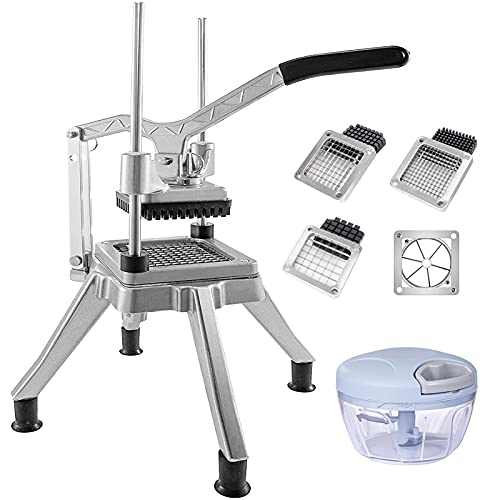
BotaBay 19-Inch Lever Food Chopper with 4 Blades
Best for: Manual dicing of dense vegetables
- Power Source
- Manual
- Operation Mechanism
- Lever Style
- Cut Size
- 6-wedge, 1/4", 3/8", 1/2"
- Blade Material
- 304 stainless steel
- Blade Count
- 4
- Recommended Food
- Onions, Potatoes, French Fries, Tomatoes, Fruits
View on Amazon: BotaBay 19-Inch Lever Food Chopper with 4 Blades Affiliate link
This BotaBay manual chopper uses a 19-inch lever to press food through four 304 stainless steel blades. It offers 1/4, 3/8, 1/2 inch dices and 6-wedge slices. The aluminum alloy frame and washable parts support commercial use. You get uniform cuts without electricity. The 10-pound build provides stability during heavy prep tasks.
Pros
- Lever-style mechanism for easy pressing
- Four 304 stainless steel blades
- Aluminum alloy die-cast frame
- Washable and disassemblable parts
Cons
- Manual operation requires physical effort
- Heavy 10-pound build
- Large 18-inch width footprint
Good fit if
- You need uniform dices without power
- You prefer manual lever control
- You chop dense vegetables frequently
Skip if
- You want electric speed
- You have limited counter space
- You need cordless portability
Verdict: BotaBay 19in Manual Food Chopper suits you if you want sturdy, manual precision for commercial-style dicing without the bulk of electric units.
Specifications side by side
| Spec | VEVOR Commercial 1/4-Inch Vegetable Chopper | BotaBay 19-Inch Lever Food Chopper with 4 Blades |
|---|---|---|
| Power Source | not stated | Manual |
| Operation Mechanism | Pull-down handle | Lever Style |
| Cut Size | 1/4 inch | 6-wedge, 1/4", 3/8", 1/2" |
| Blade Material | 420J2 stainless steel | 304 stainless steel |
| Blade Count | not stated | 4 |
| Material | Stainless Steel | Stainless Steel |
| Recommended Food | Onions, Potatoes, French Fries, Carrots, Fruits | Onions, Potatoes, French Fries, Tomatoes, Fruits |
| Color | Stainless Steel | Silver |
| Intended Use | Commercial, Home Use | Commercial |
| Use | Vegetables, Commercial Use | Vegetables, Commercial Use |
| Dimensions | 7.9 × 6.1 × 18.5 inches | 7 × 18 × 7 inches |
| Weight | 5.07 pounds | 10 pounds |
| Size | Push style 1/4″ | 19in Lever Style Chopper + 4 Blade |
| Model | QTJ-J002 | 002 |
Frequently asked questions
Which food chopper is better for making French fries?
The VEVOR Commercial 1/4-Inch Vegetable Chopper is the better choice for consistent French fry preparation. It is specifically designed for precise 1/4-inch cuts, which is the standard size for many fry recipes. The unit features a push-style mechanism that helps you achieve uniform slices quickly. Its compact 6.1-inch width makes it easy to store when not in use.
How many blades does the BotaBay chopper include?
The BotaBay 19-Inch Lever Food Chopper comes with four interchangeable blades. This set allows you to dice vegetables into 1/4-inch, 3/8-inch, and 1/2-inch cubes, or create 6-wedge slices. Having multiple blade options means you can handle various recipes without needing to buy additional tools. The blades are made of stainless steel for durability during heavy commercial use.
What is the weight difference between these two choppers?
The BotaBay chopper is significantly heavier than the VEVOR model. The BotaBay unit weighs 10 pounds, providing stability during the lever-pressing action. The VEVOR chopper weighs 5.07 pounds, making it lighter and easier to move around the kitchen. If you prefer a stationary, heavy-duty tool, the BotaBay is the better option. For portability, the VEVOR is superior.
Can I use these choppers for onions and tomatoes?
Yes, the BotaBay chopper is recommended for onions and tomatoes. Its lever mechanism provides the steady pressure needed to cut through these dense or juicy vegetables effectively. The VEVOR model is primarily recommended for French fries and general vegetable slicing. While it can handle other produce, its 1/4-inch fixed cut size limits versatility for items like tomatoes.
Which chopper has a larger cutting area?
The BotaBay chopper offers a larger overall footprint and cutting capacity. It measures 18 inches in width and 19 inches in length, providing ample space for larger batches of vegetables. The VEVOR chopper is more compact, measuring 7.9 inches in length and 6.1 inches in width. This makes the VEVOR better for small kitchens or limited counter space.
Is the VEVOR chopper suitable for commercial kitchens?
Yes, the VEVOR Commercial 1/4-Inch Vegetable Chopper is intended for commercial use. It is built with a stainless steel finish and a sturdy push-style design to withstand frequent use. Its focus on precise 1/4-inch cuts makes it ideal for high-volume prep tasks like frying. The model QTJ-J002 is designed to meet the demands of busy professional environments.
What color options are available for these choppers?
The VEVOR chopper is available in a stainless steel color, which matches its commercial-grade build. The BotaBay chopper is listed in silver. Both finishes are practical for kitchen environments as they resist stains and are easy to clean. The color choice does not affect performance, as both units rely on their mechanical design and blade quality for results.