POWLAB 1/4-Inch Commercial Vegetable Chopper vs POWLAB 3/8" Manual Vegetable Chopper (2026): Key Differences
As an Amazon Associate we earn from qualifying purchases. Links on this page are affiliate links.
You are looking at the powlab 1 4 inch commercial vegetable chopper vs 3 8 manual vegetable dicer. Both units share an aluminum alloy frame, stainless steel blades, and manual pull-down operation. They measure the same physical dimensions and target commercial kitchens. The main difference lies in the cut size. One produces 1/4-inch pieces, while the other creates 3/8-inch chunks. This change affects how the vegetables look and cook.
Key differences
| Aspect | POWLAB 1/4-Inch Commercial Vegetable Chopper | POWLAB 3/8" Manual Vegetable Chopper |
|---|---|---|
| Cut Size | 1/4 inch (0.6 cm) | 3/8 inch (0.95 cm) |
| Blade Material | 420 stainless steel | High-density refined stainless steel |
| Model | 1/4" Chopper | 1IN1 |
| Dimensions | 8.6 x 8.6 x 20 inches | 8.6 x 8.6 x 20 inches |
| Power Source | Manual | Manual |
Which one should you choose?
Choose POWLAB 1/4-Inch Commercial Vegetable Chopper if
- You need smaller, uniform 1/4-inch dice for salads or salsas.
- You prefer the specific 420 stainless steel blade composition.
- You want a model explicitly labeled for 1/4-inch cuts.
Choose POWLAB 3/8" Manual Vegetable Chopper if
- You require larger 3/8-inch chunks for soups or stews.
- You want blades described as high-density refined stainless steel.
- You prefer the model designated as 1IN1.
Verdict: Choose the 1/4-inch model if you need fine, consistent dice for dishes like salsas or salads. Select the 3/8-inch version if your recipes call for larger chunks that hold their shape better during cooking. Both offer the same manual efficiency and durable build.
POWLAB Chopper Cut Size Comparison
Cut size precision
Product A delivers a consistent 1/4-inch (0.6 cm) cut. This smaller size suits dishes requiring fine dicing, such as salsas or quick-cooking stir-fries. Product B offers a 3/8-inch (0.95 cm) cut. This larger size is better for heartier vegetables that hold their shape during cooking. You choose based on the texture you need. If you prefer uniform, smaller pieces for faster cooking or specific recipes, Product A wins. If you want larger, chunkier pieces that retain more texture, Product B is the better choice. The difference is clear and functional.
Blade material quality
Product A uses 420 stainless steel for its blade assembly. This grade offers good corrosion resistance and durability for commercial use. Product B specifies high-density refined stainless steel blades. This description suggests a focus on maintaining sharpness and resisting corrosion from acidic foods or water. Both frames are aluminum alloy. The blade material difference is subtle. Product A specifies the exact steel grade, which provides a concrete specification. Product B emphasizes the refinement and density of the steel. Both are designed for longevity. You get reliable performance from either option, though the specific grade in Product A is more explicitly stated in the data.
Recommended food types
Product A lists cucumbers, potatoes, onions, mushrooms, apples, and pears as suitable items. It does not list restrictions. Product B lists similar items but explicitly notes that hard vegetables like carrots and potatoes are not recommended to maintain blade longevity. This restriction is a significant practical difference. If you plan to dice hard root vegetables frequently, Product A is the safer choice without explicit warnings. Product B requires you to avoid certain hard items to protect the blades. This limitation affects your versatility in the kitchen when dealing with tougher produce.
Physical dimensions
Both units share identical external measurements. Product A measures 8.6 inches in width, 8.6 inches in length, and 20 inches in height. Product B matches these exact dimensions: 8.6 inches wide, 8.6 inches long, and 20 inches tall. The footprint and vertical space required are the same. This consistency means they fit similarly in commercial prep areas or home kitchens. Storage requirements are also identical. You will not gain or lose space by choosing one over the other. The physical presence of both choppers is indistinguishable in terms of size and scale.
Intended use context
Both products are labeled for commercial use. Product A is described as a commercial vegetable chopper with a manual operation mechanism. Product B is also a commercial chopper intended for professional restaurants and home kitchens. Both feature manual pull-down operation. The intended use is identical. You can deploy either unit in a busy kitchen environment. The manual mechanism requires physical effort but offers control. The commercial designation suggests robust construction for frequent use. There is no functional difference in their target market or professional application based on the provided specifications.
Which POWLAB chopper fits your prep needs
Users needing fine dice for salsas
Choose the 1/4-inch model when your recipes demand small, uniform pieces. The 0.6 cm cut size works well for salsas, quick-cooking stir-fries, or garnishes where texture matters. This chopper ensures consistent results every time you pull down the pusher block, making it ideal for dishes that require finer dicing.
Users preferring larger chunks for stews
Select the 3/8-inch model if you prefer substantial vegetable chunks. The 0.95 cm cut size is better for stews, roasts, or salads where you want the vegetables to hold their shape during cooking. This larger dicing pattern reduces prep time while maintaining the structural integrity of your ingredients.
Commercial kitchens with high volume needs
Both units feature durable aluminum alloy frames and 420 stainless steel blades, but the 1/4-inch option offers higher efficiency for large volumes. The finer cut size allows you to process more ingredients in less time, which is crucial for busy commercial environments. The detachable parts also ensure hassle-free cleaning between rushes.
The products compared

POWLAB 1/4-Inch Commercial Vegetable Chopper
Best for: Uniform 1/4-inch manual dicing
- Power Source
- Manual
- Operation Mechanism
- Pull down pusher block
- Cut Size
- 1/4" (0.6 cm)
- Blade Material
- 420 stainless steel
- Function
- Dice
- Recommended Food
- Fruits
View on Amazon: POWLAB 1/4-Inch Commercial Vegetable Chopper Affiliate link
This manual vegetable chopper features a 1/4-inch cut size, ideal for uniform dicing. The frame is die-cast aluminum alloy with 420 stainless steel blades. You operate it by pulling down a pusher block. It measures 8.6 by 20 inches. The design allows for easy disassembly and cleaning. This tool suits users needing consistent 1/4-inch pieces for commercial or home cooking.
Pros
- Produces consistent 1/4-inch (0.6 cm) cuts
- Durable die-cast aluminum alloy frame
- 420 stainless steel blades resist corrosion
- Parts disassemble for easy washing
Cons
- Requires manual force to operate
- 20-inch height requires vertical storage space
- Single 1/4-inch blade size only
Good fit if
- You need uniform 1/4-inch vegetable pieces
- You prefer manual operation over electric
- You want a durable aluminum build
Skip if
- You require multiple cut sizes
- You want hands-free electric operation
- You have limited vertical counter space
Verdict: POWLAB 1/4" Manual Vegetable Chopper delivers consistent 1/4-inch dicing through a sturdy aluminum frame and manual pusher mechanism. It fits buyers who prioritize uniform cuts and durable construction over automated convenience.
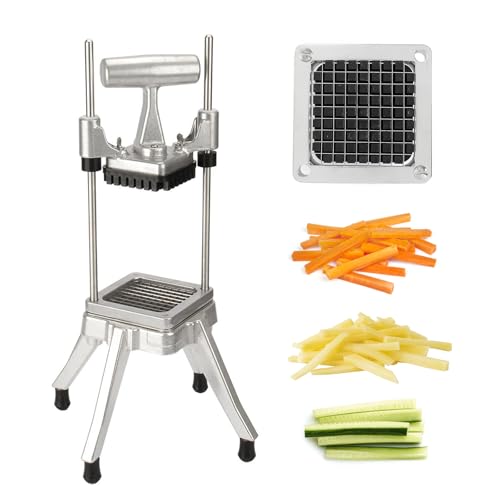
POWLAB 3/8" Manual Vegetable Chopper
Best for: Uniform 3/8-inch dicing of soft produce
- Power Source
- Manual
- Operation Mechanism
- Pull down
- Cut Size
- 3/8" (0.95 cm)
- Blade Material
- 420 stainless steel
- Function
- Dice
- Recommended Food
- Fruits
View on Amazon: POWLAB 3/8" Manual Vegetable Chopper Affiliate link
This manual dicer cuts vegetables into 3/8-inch cubes using a stainless steel blade and aluminum alloy frame. The 8.6-inch square base supports the 20-inch tall assembly. You get detachable parts for easy cleaning. It suits busy kitchens and commercial settings. The design reduces prep time for soft produce like cucumbers and onions. You must avoid hard vegetables to protect the blades.
Pros
- 3/8-inch cut size for uniform dicing
- Stainless steel blades resist corrosion
- Aluminum alloy frame for durability
- Detachable parts for easy cleaning
Cons
- Not recommended for hard vegetables like carrots
- Manual operation requires physical effort
- Large 20-inch height takes up counter space
Good fit if
- You need consistent 3/8-inch cubes
- You prefer stainless steel construction
- You chop soft vegetables frequently
Skip if
- You process hard root vegetables often
- You want an electric motor
- You need a compact footprint
Verdict: POWLAB 3/8 Manual Vegetable Chopper works well if you chop soft produce and want durable stainless steel parts. It fits commercial kitchens that need uniform 3/8-inch cuts without electric power.
Specifications side by side
| Spec | POWLAB 1/4-Inch Commercial Vegetable Chopper | POWLAB 3/8" Manual Vegetable Chopper |
|---|---|---|
| Power Source | Manual | Manual |
| Operation Mechanism | Pull down pusher block | Pull down |
| Cut Size | 1/4" (0.6 cm) | 3/8" (0.95 cm) |
| Blade Material | 420 stainless steel | 420 stainless steel |
| Function | Dice | Dice |
| Material | Stainless Steel | Stainless Steel |
| Recommended Food | Fruits | Fruits |
| Color | Silver | Silver |
| Intended Use | Commercial | Commercial |
| Use | Vegetables, Commercial Use | Vegetables, Commercial Use |
| Dimensions | 8.6 × 8.6 × 20 inches | 8.6 × 8.6 × 20 inches |
| Size | 1/4" | 3/8'' |
| Model | 1/4" Chopper | 1IN1 |
Frequently asked questions
Which POWLAB chopper is better for commercial kitchens?
Both models serve commercial kitchens well due to their stainless steel construction and manual operation. The 1/4-inch model suits tasks needing fine, uniform dicing. The 3/8-inch model is ideal for larger cuts of soft produce. Choose based on the specific cut size your recipes require for consistent results.
Do these choppers have electric motors?
No, neither unit uses electricity. Both operate via a manual pusher mechanism. You apply physical pressure to push vegetables through the blades. This design offers durability and control without the need for power cords or battery replacements in your prep station.
Are the blades made of stainless steel?
Yes, both choppers feature stainless steel blades. This material resists rust and maintains sharpness during heavy use. Stainless steel also ensures easy cleaning and hygiene, which is critical for commercial food preparation environments where sanitation standards are strict.
What are the physical dimensions of these choppers?
Both units measure 8.6 inches in width, 8.6 inches in length, and 20 inches in height. They share the same footprint and vertical profile. This consistent sizing helps you plan your kitchen workspace layout effectively, as they occupy the same amount of counter space.
Can I use these for soft vegetables?
Yes, both are suitable for soft produce. The 3/8-inch model is specifically noted for handling soft vegetables effectively. The 1/4-inch model also works well for uniform dicing of softer items. Their manual design allows you to control the pressure applied to delicate ingredients.
Is there a difference in color between the models?
Both choppers are described as silver in color. This matches their stainless steel and aluminum alloy construction. The visual appearance is consistent across both models, so you cannot distinguish them by color alone. You must check the cut size specification to identify each unit.
Which model is better for salsas?
The 1/4-inch model is better for salsas. Its smaller cut size produces the fine, uniform dice often required for salsa recipes. The 3/8-inch model creates larger pieces that may not provide the desired texture for this specific dish. Consistency in cut size matters for salsa quality.
Are these choppers intended for home use only?
No, both are intended for commercial use. They are built to withstand the demands of professional kitchens. The sturdy aluminum frame and stainless steel components support frequent, heavy-duty operation. They are designed for environments where volume and durability are prioritized over compact home storage.