Electric vs Manual Food Slicers: Which Should You Buy?
As an Amazon Associate we earn from qualifying purchases. Links on this page are affiliate links.
Choosing between an electric vs manual food slicer depends on your power needs and workload. Both models slice meats, cheeses, and vegetables with adjustable thickness settings and stainless steel blades. The main difference lies in the power source. One uses a 150-watt motor for continuous slicing, while the other relies on hand-cranking. This affects speed, effort, and ideal use cases. You must decide which operation type fits your kitchen routine best.
Key differences
| Aspect | OSTBA 7.5-Inch 150W Electric Meat Slicer | TERUISI Manual Stainless Steel Vegetable Slicer |
|---|---|---|
| Power Source | Electric motor | Manual crank |
| Wattage | 150W | Not listed |
| Cut Thickness | Super thin to approx. 3/4" | 0 - 0.5 in |
| Blade Material | Stainless steel | 420 stainless steel |
| Recommended Food | Meat, deli, cheese | Vegetables, commercial use |
Which one should you choose?
Choose OSTBA 7.5-Inch 150W Electric Meat Slicer if
- You need to slice tough meats or large quantities quickly without physical effort.
- You want a thicker maximum cut setting up to 3/4 inch.
- You prefer a motorized operation for consistent, high-yield slicing.
Choose TERUISI Manual Stainless Steel Vegetable Slicer if
- You primarily slice vegetables like potatoes, onions, or tomatoes.
- You want a fully stainless steel body that is easy to wipe clean.
- You prefer a manual operation that does not require electrical power.
Verdict: The electric slicer suits those who process large volumes of meat or need variable thickness up to three-quarters of an inch. The manual model is better for vegetable prep and users who prioritize a all-metal, cord-free design. Your choice depends on whether you value motorized speed or manual control.
Electric vs Manual Slicer Specs
Power Source
The OSTBA model relies on a 150-watt electric motor to drive the slicing action. You plug it in and let the machine do the work, which is ideal for high-volume tasks or tough meats. The TERUISI slicer is strictly manual. You operate it by gripping a handle and rotating the mechanism by hand. This requires physical effort but eliminates the need for an electrical outlet. If you prefer consistent, automated slicing without worrying about cords or power limits, the electric option is the clear choice. For portable, cord-free use, the manual design wins.
Cut Thickness
Thickness control varies significantly between these two units. The OSTBA electric slicer offers an adjustable range from super thin to approximately 3/4 inch. This wide span allows you to create paper-thin deli slices or thick steaks with ease. The TERUISI manual slicer adjusts from 0 to 0.5 inches (0 to 13 mm). While this provides precise control for vegetables and fruits, it cannot match the maximum thickness capability of the electric model. If you frequently slice thick roasts or large cuts of meat, the OSTBA provides greater versatility. For standard vegetable prep, both handle the job well.
Blade Material
Both slicers feature stainless steel blades for durability and corrosion resistance, but the specific grades differ. The OSTBA uses a 7.5-inch serrated stainless steel blade driven by the motor. The TERUISI utilizes a 420 stainless steel blade. While the exact dimensions of the manual blade are not listed, the 420 grade is known for good edge retention and hardness. The electric model’s larger 7.5-inch blade may handle larger food items more easily. However, the manual slicer’s blade is designed for efficient rotation. For general slicing tasks, both materials are suitable, making this a tie in terms of basic functionality.
Recommended Use
The intended applications for these devices are quite distinct. The OSTBA is marketed for slicing meat, deli products, cheese, roast beef, turkey breast, vegetables, and fruits. Its electric power makes it well-suited for tougher proteins. The TERUISI is recommended specifically for onions, potatoes, tomatoes, and other vegetables, with an intended use labeled as commercial vegetable cutting. While it can handle fruits, it is not designed for heavy meat slicing. If your primary goal is preparing meats and deli items, the OSTBA is the better tool. For heavy vegetable prep, the TERUISI is specialized for that task.
Size and Weight
Physical dimensions and weight impact storage and stability. The OSTBA measures 14.2 inches in length, 9.65 inches in width, and 10.2 inches in height, weighing 8.6 pounds. The TERUISI is wider at 15.4 inches but shorter in length at 11.2 inches, with a height of 13.6 inches and a weight of 7.92 pounds. The manual slicer is slightly lighter but takes up more counter width. The electric model is more compact in footprint but heavier due to the motor. If you have limited counter space, the electric model’s narrower width might be preferable. For stability during manual operation, the wider base of the TERUISI helps keep it in place.
Which Slicer Fits Your Kitchen Needs
Users slicing tough meats frequently
The OSTBA slicer uses a 150-watt electric motor to handle dense meats like roast beef and turkey breast. Its 7.5-inch stainless steel blade provides consistent power for thick cuts up to 3/4 inch. The safety lock and suction feet ensure stability during high-yield slicing tasks without manual effort.
Commercial prep for vegetables
The TERUISI manual slicer features a large feed chute measuring 8.7 by 3.7 inches, handling potatoes and onions easily. Its 304 stainless steel body is durable for commercial use. The spring-loaded pusher offers precise control, while the 0 to 0.5-inch adjustment knob ensures even slices for high-volume vegetable prep.
Those prioritizing easy cleanup
Cleaning the TERUISI slicer is straightforward. The blade removes easily for rinsing, and the stainless steel casing wipes clean with a cloth. The manual operation eliminates complex electrical components, reducing maintenance needs. Its simple design allows you to sanitize the unit quickly after slicing vegetables or fruits for daily meals.
Users needing adjustable thickness control
The OSTBA electric slicer offers adjustable thickness from super thin to approximately 3/4 inch. This range accommodates various foods, from delicate deli meats to thick cheese slices. The 150-watt motor ensures consistent cuts regardless of thickness settings, making it versatile for preparing different ingredients with precision and uniformity for your recipes.
Quick picks
| # | Product | Best for | Price |
|---|---|---|---|
| 1 | OSTBA 7.5-Inch 150W Electric Meat Slicer | home slicing of meats and cheeses | Check price of OSTBA 7.5-Inch 150W Electric Meat Slicer on Amazon |
| 2 | TERUISI Manual Stainless Steel Vegetable Slicer | Manual precision slicing tasks | Check price of TERUISI Manual Stainless Steel Vegetable Slicer on Amazon |
The products compared
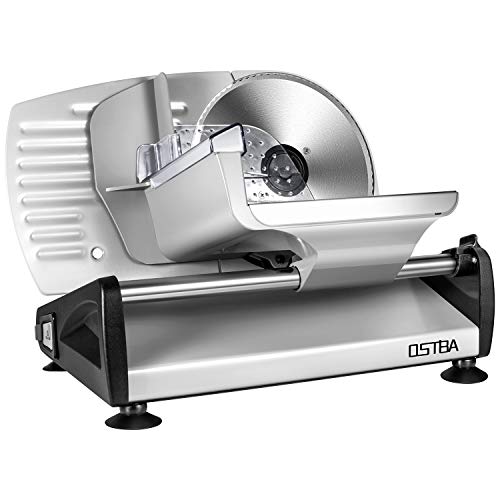
OSTBA 7.5-Inch 150W Electric Meat Slicer
Best for: home slicing of meats and cheeses
- Power Source
- Electric (what this guide is about)
- Operation Type
- Electric motor
- Blade Count
- 1
- Cut Types
- Slice
- Cut Thickness
- 0-15mm
- Blade Material
- Stainless steel
View on Amazon: OSTBA 7.5-Inch 150W Electric Meat Slicer Affiliate link
The OSTBA SL518-1 is an electric meat slicer with a 150-watt motor and a 7.5-inch stainless steel blade. It slices from super thin to 3/4 inch thick. The unit weighs 8.6 pounds and measures 14.2 inches long. Removable parts make cleaning easy. You get consistent cuts for meat, cheese, and vegetables. This model suits home cooks who want precision without commercial bulk.
Pros
- 150-watt electric motor for consistent slicing
- 7.5-inch stainless steel serrated blade
- Adjustable thickness from super thin to 3/4 inch
- Removable parts for easy cleaning
- Dual safety lock and power button
Cons
- 150-watt motor is lower power than 200-watt variants
- Heavier build at 8.6 pounds
- No mention of automatic feed mechanism
Good fit if
- You need precise thickness control for deli-style meats
- You want a compact electric slicer for home use
- You prefer manual thickness adjustment over automatic settings
Skip if
- You require a motor stronger than 150 watts
- You need to slice items thicker than 3/4 inch
- You want a lighter unit under 8 pounds
Verdict: The OSTBA 7.5" Electric Meat Slicer delivers reliable home slicing with a 150-watt motor and adjustable thickness. It fits users who value precision and easy cleaning over high-volume commercial performance.

TERUISI Manual Stainless Steel Vegetable Slicer
Best for: Manual precision slicing tasks
- Power Source
- Manual (what this guide is about)
- Operation Type
- Manual
- Cut Types
- Slice
- Cut Thickness
- 0 - 0.5 in (0 - 13 mm)
- Blade Material
- 420 stainless steel
- Body Material
- 304 stainless steel
View on Amazon: TERUISI Manual Stainless Steel Vegetable Slicer Affiliate link
This manual slicer uses a hand-cranked design to slice vegetables without electricity. It features a 304 stainless steel body and a 420 stainless steel blade. You can adjust thickness from 0 to 0.5 inches. The unit weighs 7.92 pounds and includes suction cups for stability. It suits those who want precise control and easy cleaning without plugging in a machine.
Pros
- Adjustable thickness from 0 to 0.5 inches
- 304 stainless steel body resists rust
- 420 stainless steel blade for durability
- Suction cups keep unit stable during use
Cons
- Requires manual hand-cranking effort
- No motorized feed mechanism
- Heavier at 7.92 pounds for manual operation
Good fit if
- You want precise, manual control over slice thickness
- You prefer not to use electrical outlets
- You need a unit that is easy to rinse clean
Skip if
- You need to slice large volumes quickly
- You prefer motorized convenience
- You want to slice hard items with minimal effort
Verdict: TERUISI Manual Vegetable Slicer offers stable, precise slicing for small batches. It fits users who value manual control and easy cleaning over speed.
Specifications side by side
| Spec | OSTBA 7.5-Inch 150W Electric Meat Slicer | TERUISI Manual Stainless Steel Vegetable Slicer |
|---|---|---|
| Operation Type | Electric motor | Manual |
| Blade Count | 1 | not stated |
| Cut Types | Slice | Slice |
| Cut Thickness | 0-15mm | 0 - 0.5 in (0 - 13 mm) |
| Blade Material | Stainless steel | 420 stainless steel |
| Body Material | not stated | 304 stainless steel |
| Safety Features | Safety lock, suction feet, food pusher | Suction cups, spring-loaded pusher |
| Function | not stated | Slice |
| Wattage | 150W | not stated |
| Power Source | Electric | Manual |
| Material | Stainless Steel | Stainless Steel |
| Recommended Food | Bread | Onions, Potatoes, Tomatoes, Fruits |
| Color | Silver | Silver |
| Intended Use | not stated | Commercial |
| Use | Meat | Vegetables, Commercial Use |
| Features | Adjustable Thickness, Child Lock | Adjustable Thickness |
| Intended Food | Cheese | not stated |
| Dimensions | 14.2 × 9.65 × 10.2 inches | 11.2 × 15.4 × 13.6 inches |
| Weight | 8.6 pounds | 7.92 pounds |
| Size | 7.5"x1 Blades-150 watts | Manual Model |
| Model | SL518-1 | SL-04 |
Frequently asked questions
Is an electric food slicer safer than a manual one?
Electric models like the OSTBA offer built-in safety features such as finger guards and stable bases. The motor drives the blade, keeping your hands away from the cutting edge. Manual slicers require you to push food directly against the blade. This demands more focus and steady hand control to avoid accidental cuts during use.
Which slicer is better for slicing hard cheeses?
The OSTBA 150-watt electric slicer handles hard cheeses with ease. Its motor provides consistent power to slice through dense blocks without jamming. Manual slicers can struggle with very hard varieties, requiring significant arm strength. For frequent cheese slicing, the electric option ensures uniform thickness with less physical effort.
Do manual food slicers require electricity to operate?
No, manual slicers like the TERUISI model operate entirely by hand. You do not need to plug them into a power outlet. This makes them portable and usable anywhere. Electric slicers require a standard electrical connection to run their motors. Choose manual if you need cordless flexibility for outdoor or travel use.
How much counter space does an electric slicer take up?
The OSTBA electric slicer measures 14.2 inches in length and weighs 8.6 pounds. It requires a stable, flat surface to operate safely. Manual slicers can be larger or bulkier depending on the frame design. Check your counter dimensions before buying. Electric models often have a more compact footprint relative to their capacity.
Can I slice vegetables with an electric meat slicer?
Yes, electric slicers can handle vegetables, though they are optimized for meat. The OSTBA model features a stainless steel blade suitable for various foods. However, soft vegetables may stick to the blade. Manual slicers like the TERUISI are often preferred for vegetables like onions and potatoes due to precise manual control and easier cleanup.
Which slicer is easier to clean after use?
Manual slicers often have fewer crevices and no motor housing, making them simpler to rinse. The TERUISI stainless steel construction allows for quick wiping. Electric slicers have more parts, including the motor base and blade guard. You must unplug the unit and carefully clean around the blade assembly. Both require thorough drying to prevent rust.
Is a 150-watt motor enough for home use?
A 150-watt motor, like the one in the OSTBA slicer, is sufficient for typical home tasks. It handles standard roasts, deli meats, and cheeses without issue. It is not designed for heavy commercial daily use. If you slice large quantities daily, consider a higher wattage model. For occasional home prep, 150 watts provides reliable performance.