2 Speeds vs 3 Speeds Food Processors: Which Should You Buy?
As an Amazon Associate we earn from qualifying purchases. Links on this page are affiliate links.
Choosing between a 2 Speeds vs 3 Speeds food processor often comes down to texture control versus raw power. Both the Ganiza and SPZTJK models offer 8-cup dual bowls for separating meat and vegetables. They share full-copper motors and automatic safety stops. The main difference lies in their motor wattage and speed options. One prioritizes higher power for tougher tasks, while the other offers finer speed adjustments for delicate prep.
Key differences
| Aspect | Ganiza 8-Cup Dual Bowl Food Chopper | SPZTJK 8-Cup 3-Speed Dual-Bowl Food Grinder |
|---|---|---|
| Speed Settings | 2 speeds | 3 speeds |
| Motor Power | 450 W | 300 W |
| Included Blades | Bi-level S-blades | not listed |
| Dimensions | 7 x 13 x 8 inches | 8.66 x 10.2 x 5.51 inches |
| Recommended Use | Meat | Baby Food, Vegetables, Meat |
Which one should you choose?
Choose Ganiza 8-Cup Dual Bowl Food Chopper if
- You need higher wattage (450 W) for tougher chopping tasks.
- You prefer a taller, narrower footprint for vertical storage.
- You want a specific bi-level blade design for consistent results.
Choose SPZTJK 8-Cup 3-Speed Dual-Bowl Food Grinder if
- You want three speed settings for precise texture control.
- You plan to make baby food or softer purees.
- You prefer a wider, shorter base for stable counter placement.
Verdict: Choose the Ganiza if you need more power for heavy-duty meat grinding. Pick the SPZTJK if you value extra speed options for delicate baby food or vegetable prep. Both handle basic chopping well with their dual-bowl designs.
2 Speeds vs 3 Speeds Comparison
Speed Control
The SPZTJK offers three distinct speed settings, giving you more granular control over texture. This allows for precise adjustments when processing delicate items like baby food or firm meats. The Ganiza provides only two speeds, which simplifies operation but limits your ability to fine-tune results. If you frequently switch between coarse chopping and fine purees, the extra gear on the SPZTJK provides a functional advantage. The Ganiza relies on a simpler two-level approach, which may suffice for basic tasks but lacks the versatility of the three-speed option.
Motor Power
The Ganiza features a 450-watt motor, significantly outpacing the SPZTJK’s 300-watt unit. This higher wattage suggests the Ganiza can handle tougher ingredients with less strain, potentially offering faster processing times for dense vegetables or meats. The SPZTJK’s lower power rating is adequate for soft items and general prep but may struggle with harder tasks. Both units utilize full-copper motors for durability, but the Ganiza’s raw power output is superior. If you prioritize speed and torque for heavy-duty chopping, the Ganiza holds the clear edge.
Bowl Materials
Both processors include dual 8-cup bowls made from glass and 304 stainless steel, promoting hygiene by separating meat and vegetable prep. The Ganiza explicitly notes that its glass bowl has a maximum temperature limit of 149°F to prevent shattering, a crucial detail for safety. The SPZTJK lists its materials as food-grade stainless steel and BPA-free glass but does not specify thermal limits in the provided data. Both designs support easy cleaning with removable parts. Since both offer identical bowl configurations and materials, this aspect remains a tie for practical kitchen use.
Dimensions
The SPZTJK has a wider footprint, measuring 8.66 inches in width, compared to the Ganiza’s 7-inch width. However, the SPZTJK is shorter at 10.2 inches tall, while the Ganiza stands taller at 13 inches. The Ganiza’s length is 8 inches, whereas the SPZTJK is narrower at 5.51 inches. These differences affect how each unit fits on your counter. The Ganiza is taller but narrower, while the SPZTJK is wider but more compact in height. Neither model is universally smaller; the best choice depends on your specific counter space dimensions.
Safety Features
Both models prioritize safety with automatic stopping mechanisms. The Ganiza uses a patented design where spring-loaded blades stop rotating immediately when the motor is removed, protecting users and children. It also features an overheat protection light display to indicate when the unit needs to cool down. The SPZTJK includes a similar automatic stop and overheat protection system, advising users to let the machine cool before restarting. Both units ensure safe operation during use. Since both implement comparable safety protocols and shutdown features, this aspect is a tie.
Which 2 or 3 Speed Model Fits You
You want precise texture for baby food
The SPZTJK offers three speed settings for finer control over ingredient consistency. This extra setting helps you process delicate items like baby food or soft vegetables without overworking them. The three-speed option provides the granular adjustments needed for specific culinary tasks that two speeds cannot match.
You need power for tough meats
The Ganiza features a 450-watt motor, providing more raw power than the 300-watt SPZTJK. This higher wattage supports efficient chopping of meats and fibrous vegetables. The dual 8-cup bowls allow you to separate tasks, while the stronger motor ensures quick results for tougher ingredients without straining the unit.
You prefer simple, straightforward operation
The Ganiza’s two-speed design simplifies your workflow by reducing the number of choices. You can select between low or high speed for most common tasks. This straightforward approach minimizes decision-making time during prep. The ergonomic button design further enhances ease of use for quick, daily kitchen chores.
Quick picks
| # | Product | Best for | Price |
|---|---|---|---|
| 1 | Ganiza 8-Cup Dual Bowl Food Chopper | Separating meat and vegetable prep | Check price of Ganiza 8-Cup Dual Bowl Food Chopper on Amazon |
| 2 | SPZTJK 8-Cup 3-Speed Dual-Bowl Food Grinder | Separating meat and veg prep tasks | Check price of SPZTJK 8-Cup 3-Speed Dual-Bowl Food Grinder on Amazon |
The products compared

Ganiza 8-Cup Dual Bowl Food Chopper
Best for: Separating meat and vegetable prep
- Speed Settings
- 2 Speeds (what this guide is about)
- Bowl Capacity
- 8 cups
- Motor Power
- 450 W
- Included Blades
- S stainless steel blades
- Material
- Glass
- Color
- Silver
View on Amazon: Ganiza 8-Cup Dual Bowl Food Chopper Affiliate link
This Ganiza unit offers two cutting speeds and a 450-watt motor to handle chopping and grinding tasks. It includes dual 8-cup bowls in glass and stainless steel, allowing you to separate meat from vegetables for better hygiene. The overheat protection light helps you monitor safe operation. It suits you if you want dedicated bowls for different ingredients without needing complex controls.
Pros
- Dual 8-cup bowls in glass and stainless steel
- 450-watt full-copper motor for consistent power
- Overheat protection light for safety monitoring
- Spring-loaded blades stop immediately when removed
Cons
- Only two speed settings limit texture control
- Glass bowl cannot exceed 149°F water
- No variable speed dial for fine tuning
Good fit if
- You want separate bowls for meat and veggies
- You prefer simple two-speed operation
- You need overheat protection feedback
Skip if
- You need more than two speed options
- You require variable speed control
- You plan to process very hot ingredients in the glass bowl
Verdict: Ganiza 8-Cup 2-Speed Food Processor provides dedicated dual bowls and a 450-watt motor for users who prioritize ingredient separation and simple operation over variable speed precision.
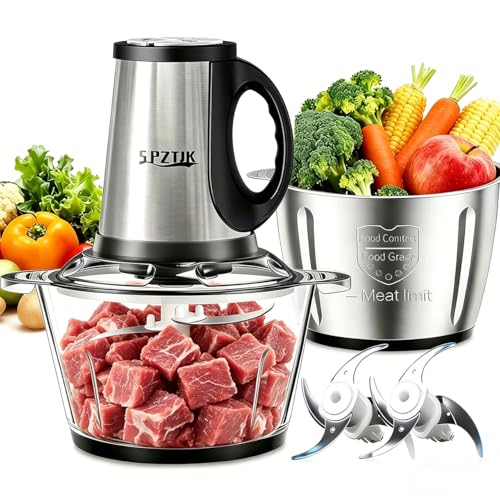
SPZTJK 8-Cup 3-Speed Dual-Bowl Food Grinder
Best for: Separating meat and veg prep tasks
- Speed Settings
- 3 Speeds (what this guide is about)
- Bowl Capacity
- 8 Cup + 8 Cup
- Motor Power
- 300W
- Power Source
- Corded electric
- Material
- Stainless Steel
- Recommended Use
- Baby Food
View on Amazon: SPZTJK 8-Cup 3-Speed Dual-Bowl Food Grinder Affiliate link
The SPZTJK 3-Speed Electric Food Processor offers 300W of power with three speed settings for precise texture control. It includes dual 8-cup bowls made from 304 stainless steel and BPA-free glass, allowing you to separate tasks like meat grinding and vegetable chopping. The unit features a full-copper motor and quiet operation. This setup suits households needing dedicated bowls for different food types while maintaining safe, hygienic prep habits.
Pros
- Three speed settings for precise texture control
- Dual 8-cup bowls in stainless steel and glass
- 300W full-copper motor for extended lifespan
- Dishwasher-safe removable parts for easy cleaning
Cons
- Motor must cool down if overheat protection triggers
- Not suitable for processing fully frozen items
- Motor base cannot be submerged in water
Good fit if
- You want separate bowls for meat and vegetables
- You need three speed options for different textures
- You prefer glass and stainless steel materials
Skip if
- You require a single large capacity bowl
- You need to process hard frozen foods directly
- You want to wash the entire unit in water
Verdict: SPZTJK 3-Speed 8-Cup Food Processor fits users who value material safety and dual-bowl separation. It delivers reliable performance for fresh ingredients through its three-speed motor and easy-clean design.
Specifications side by side
| Spec | Ganiza 8-Cup Dual Bowl Food Chopper | SPZTJK 8-Cup 3-Speed Dual-Bowl Food Grinder |
|---|---|---|
| Bowl Capacity | 8 cups | 8 Cup + 8 Cup |
| Motor Power | 450 W | 300W |
| Speed Settings | 2 speeds | 3 speeds |
| Included Blades | S stainless steel blades | not stated |
| Power Source | not stated | Corded electric |
| Wattage | not stated | 300W |
| Material | Glass | Stainless Steel |
| Recommended Use | not stated | Baby Food |
| Color | Silver | Black |
| Size | 8-Cup | 8 Cup(2L) + 8 Cup(2L) |
| Use | Meat | Vegetables, Meat |
| Dimensions | 8 × 7 × 13 inches | 5.51 × 8.66 × 10.2 inches |
| Weight | 3.53 ounces | not stated |
| Model | GC10-S | 2LJRJ-3D |
Frequently asked questions
Is a 3-speed food processor better for baby food?
Yes, the extra setting helps you process delicate items without overworking them. The SPZTJK model offers three distinct speed settings for finer control over ingredient consistency. This allows you to adjust the texture precisely when preparing soft vegetables or purees for infants.
Can a 2-speed processor handle meat effectively?
It can, but with less nuance than a 3-speed model. The Ganiza 8-Cup model provides two speeds and a 450-watt motor for users who prioritize ingredient separation. It simplifies operation for chopping meat, though it lacks the granular texture control found in more advanced models.
Do both models have dual bowls for separation?
Yes, both the Ganiza and SPZTJK models feature dual bowls. This design allows you to separate meat and vegetable prep tasks easily. You can process different ingredients simultaneously or keep them distinct to avoid cross-contamination or flavor mixing during your food preparation routine.
Which model is smaller and easier to store?
The SPZTJK model has a more compact footprint. Its dimensions are 5.51 inches in length, 8.66 inches in width, and 10.2 inches in height. The Ganiza model is slightly larger at 8 inches long and 7 inches wide, making the SPZTJK a tighter fit for small kitchens.
Is the SPZTJK motor more powerful than the Ganiza?
No, the Ganiza motor is more powerful. It features a 450-watt motor, while the SPZTJK operates at 300 watts. If you need raw power for tougher ingredients, the Ganiza might process food faster. However, the SPZTJK offers more speed options for texture control.
What material are the blades made of?
The SPZTJK model highlights stainless steel as a key material feature. This suggests durable, rust-resistant blades suitable for fresh ingredients. The data for the Ganiza model does not specify blade material, so you should check the product manual or packaging for those details before purchasing.
Does the 3-speed setting help with vegetable prep?
Yes, the third speed allows for precise adjustments when processing firm or delicate vegetables. The SPZTJK model uses this extra setting to prevent overworking soft items. You can choose the lowest speed for gentle chopping or the highest for finer mincing, depending on your recipe needs.